Blockwise & Streaming Filtering
Blockwise & Streaming Filtering
For long audio files, low-latency streaming pipelines, or memory-constrained environments,
BlockwiseFilter processes signals in contiguous chunks while maintaining the filter's delay line and phase states across boundaries.
Architecture & Delay Line Continuity
When audio is processed block by block, simple convolution truncates boundary tails,
causing audible clicks or frequency distortion at frame transitions. BlockwiseFilter preserves internal state buffers
in the native Rust engine between process() invocations.
sequenceDiagram
autonumber
participant App as Python / Audio Driver
participant Engine as BlockwiseFilter (Rust)
participant State as Internal Delay Line
rect rgb(227, 242, 253)
Note over App,State: Block 1 Arrival
App->>Engine: process(chunk_1)
activate Engine
Engine->>State: Read prior state (zeros on init)
Engine->>Engine: Convolve / IIR filter
Engine->>State: Store boundary history (len - 1 samples)
Engine-->>App: Return filtered chunk_1
deactivate Engine
end
rect rgb(232, 245, 233)
Note over App,State: Block 2 Arrival (Seamless Transition)
App->>Engine: process(chunk_2)
activate Engine
Engine->>State: Fetch stored boundary history
Engine->>Engine: Convolve seamlessly across boundary
Engine->>State: Update boundary history
Engine-->>App: Return filtered chunk_2
deactivate Engine
end
Python API: BlockwiseFilter
Basic Streaming Example
import numpy as np
from g191_filter import BlockwiseFilter

# Initialize streaming filter with 4096-sample block size
block_size = 4096
bw = BlockwiseFilter(filter_id="mod_irs16khz", block_size=block_size)

# Simulated streaming generator
def audio_stream():
    for _ in range(10):
        yield np.random.randn(block_size)

output_chunks = []
for chunk in audio_stream():
    # Process each chunk with state maintained automatically
    out_chunk = bw.process(chunk)
    output_chunks.append(out_chunk)

filtered_stream = np.concatenate(output_chunks)
State Snapshotting & Checkpointing
BlockwiseFilter exposes its complete state as a contiguous float64 NumPy array
through the .state property for serialization, pause/resume, and distributed chunk processing.
from g191_filter import BlockwiseFilter
import numpy as np

bw1 = BlockwiseFilter("irs8khz", block_size=2048)

# Process first block
out_1 = bw1.process(np.random.randn(2048))

# Save state checkpoint
saved_state = bw1.state

# Create a new instance (or restore in another worker)
bw2 = BlockwiseFilter("irs8khz", block_size=2048)
bw2.state = saved_state

# Process next block with full continuity
out_2 = bw2.process(np.random.randn(2048))
State Vector Layout
The length of the .state array depends on the internal filter topology:
| Topology | Internal State Components | Length Formula |
|---|---|---|
| FIR | Delay line history + decimation phase index k0 |
filter_len - 1 + 1 |
| IIR Parallel | Parallel biquad stage delay lines | n_stages * 2 + 1 |
| IIR Cascade | Cascade biquad stage delay lines | n_stages * 2 + 1 |
| IIR Direct | Direct form delay line history | max(deg_a, deg_b) + 1 |
Convenience Methods
bw.process_all(input_array): Feeds a complete signal through the chunking loop, returning the concatenated result.bw.reset(): Clears the delay lines and phase counters back to zero initial conditions.
Performance & Latency Comparison
| Processing Mode | Peak Memory Usage | Latency | Recommended Scenario |
|---|---|---|---|
One-Shot (filter_array) |
\(O(N)\) buffer | Duration of file | Batch datasets, short clips (< 10 min) |
Blockwise (BlockwiseFilter) |
\(O(B)\) buffer | Frame duration (\(B / f_s\)) | Real-time streams, large WAV files (> 100 MB) |
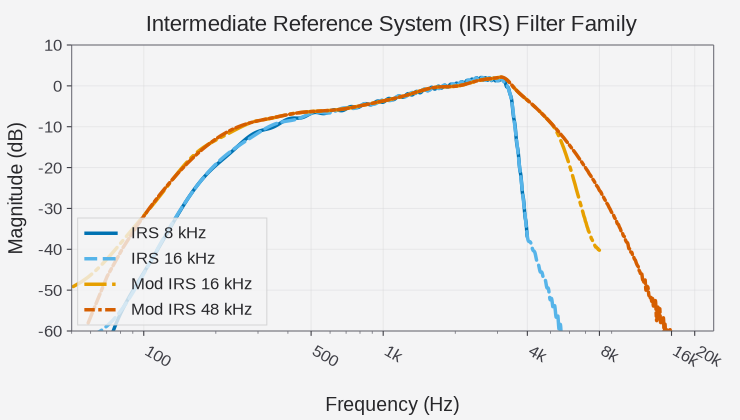
Example Filter Response