The catalogue of the ITU-T
The ITU-T is an organisation with a structure: study periods, study groups, working groups and questions. The structure changes — a study group that existed in one study period may be gone in the next, and the questions under study are replaced with every study period.
So the package does not know the structure. It reads it from the ITU-T, and it refuses an entity that does not exist instead of returning something empty.
The study periods
The ITU-T publishes a fixed list of study periods, most of them four years long — 2022-2024 is the exception, at three years. The package knows the list, so a period that does not exist cannot be built:
from itu_t_documents import StudyPeriod

StudyPeriod.from_year(2025)    # 2025-2028
StudyPeriod.containing(2026)    # 2025-2028
StudyPeriod.current()           # the period of today
StudyPeriod.all()               # every period the ITU-T knows
| Period | Code | net4 index |
|---|---|---|
| 2005-2008 | T05 |
13 |
| 2009-2012 | T09 |
14 |
| 2013-2016 | T13 |
15 |
| 2017-2020 | T17 |
16 |
| 2022-2024 | T22 |
17 |
| 2025-2028 | T25 |
18 |
| 2029-2032 | T29 |
19 |
There is no period starting in 2021: the list jumps from 2017-2020 straight to 2022-2024.
The net4 index is the number the web applications of the ITU-T use for the period.
The study groups
The study groups of a period are read from the index page of the period:
from itu_t_documents import ItuCatalogue, StudyPeriod

with ItuCatalogue() as catalogue:
    period = StudyPeriod.from_year(2025)
    [group.code for group in catalogue.study_groups(period)]
['SG02', 'SG03', 'SG05', 'SG11', 'SG12', 'SG13', 'SG15', 'SG17', 'SG20', 'SG21']
They really do change:
| Period | Study groups |
|---|---|
| 2013-2016 | 02, 03, 05, 09, 11, 12, 13, 15, 16, 17, 20 |
| 2017-2020 | 02, 03, 05, 09, 11, 12, 13, 15, 16, 17, 20 |
| 2022-2024 | 02, 03, 05, 09, 11, 12, 13, 15, 16, 17, 20 |
| 2025-2028 | 02, 03, 05, 11, 12, 13, 15, 17, 20, 21 |
SG9 and SG16 are in the 2022-2024 list but not in 2025-2028, and SG21 appears only in 2025-2028. A hard coded list would be wrong for one of the two.
Asking for a study group that the period does not have is an error, and the message names the ones that exist:
catalogue.find_study_group(9, period)
UnknownEntityError: 2025-2028 has no study group SG09; its study groups are SG02, SG03, SG05, SG11, SG12, SG13, SG15, SG17, SG20, SG21
The structure of a study group
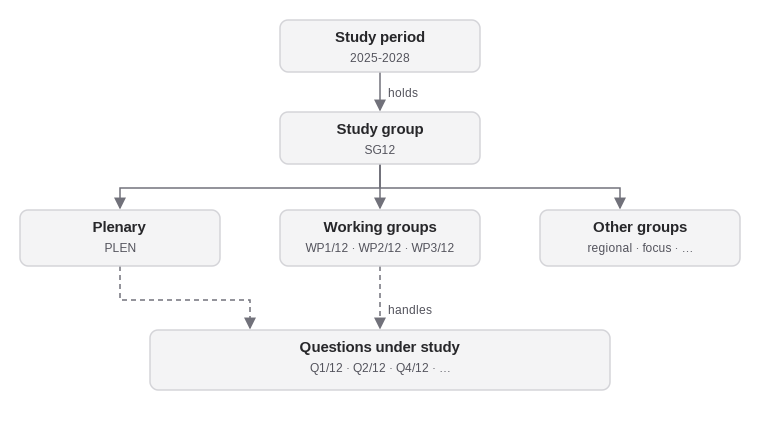
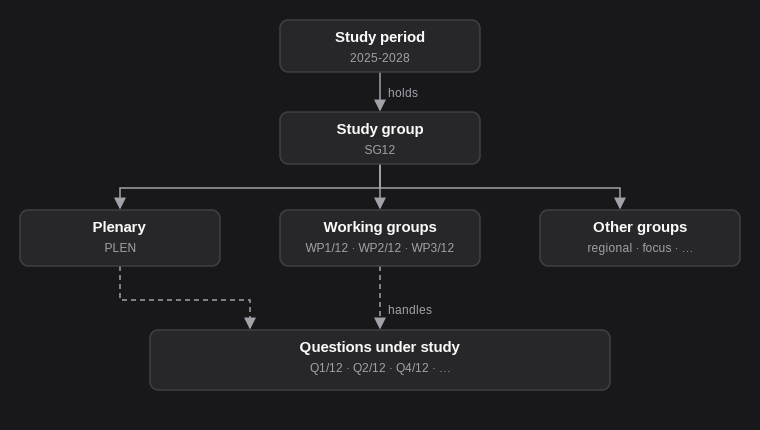
The structure page of a study group lists its plenary, its working groups, its questions under study and its other groups:
with ItuCatalogue() as catalogue:
    period = StudyPeriod.from_year(2025)
    structure = catalogue.structure(12, period)

    structure.plenary.code              # "PLEN"
    [group.code for group in structure.working_groups]   # ["WP1/12", "WP2/12", "WP3/12"]
    [question.code for question in structure.questions]   # ["Q1/12", "Q2/12", …]
    [(group.code, group.kind) for group in structure.other_groups]
[('SG12RG-AFR', 'regional'), ('SG12RG-AMR', 'regional'), ('SG12RG-AP', 'regional'), ('IRG-AVQA', 'rapporteur'), ('QSDG', 'study')]
| Code | What it is |
|---|---|
PLEN |
The plenary of the study group |
WP1/12 |
A working group |
Q5/12 |
A question under study |
SG12RG-AFR |
Any other group — a regional group, a focus group, an intersector rapporteur group, a quality study group or a joint coordination activity |
The kind of an other group is one of regional, focus, rapporteur,
coordination or study.
The questions know the working group that handles them, because a question follows its working group on the page:
structure.question(5).working_group.code   # "WP1/12"
structure.question(1).working_group.code   # "PLEN"
Asking for a question or a working group that the study group does not have is an error:
structure.question(99)
UnknownEntityError: SG12 has no question Q99/12
The search
The catalogue searches the working groups, the questions and the other groups of a period:
with ItuCatalogue() as catalogue:
    for entry in catalogue.search("speech", StudyPeriod.from_year(2025)):
        print(entry.kind, entry.code, entry.title)
question Q15/12 Parametric and E-model-based planning, prediction and monitoring of conversational speech and audio-visual quality Continuation of Q15/12
question Q4/12 Objective methods for speech and audio evaluation in vehicles Continuation of Q4/12
question Q6/12 Analysis methods for speech and audio using complex measurement signals Continuation of Q6/12
question Q7/12 Methodologies, tools and test plans for the subjective assessment of speech, audio and audiovisual quality interactions Continuation of Q7/12
The search covers the code and the title of every group of every study group
of the period, and the result is sorted by kind and then by code — so
Q15/12 comes before Q4/12.
On the command line
The same things are available without writing Python:
itu-t-documents periods
itu-t-documents study-groups --study-period 2022-2024
itu-t-documents structure --study-group 12
itu-t-documents search --search speech
And to an AI agent, through the MCP server:
| Tool | Answers |
|---|---|
list_periods |
"Which study periods are there?" |
list_study_groups |
"Which study groups does the ITU-T have?" |
list_structure |
"Which working groups does SG13 have?" |
search_structure |
"Which working group deals with speech?" |
Why not hard code it
The structure of the ITU-T is published by the ITU-T and it changes with every study period. The rules of this project are therefore simple: read the structure, never hard code it, and refuse an entity that does not exist rather than returning an empty result that looks like an answer.