The ITU-T Document Management System
The ITU-T publishes the documents of its study group meetings in the Document
Management System (DMS) on www.itu.int. This page records the URL layout,
the numbering scheme and the authentication chain that were reverse engineered
from the live pages. It is the reference the package is built on.
Document identifiers
A document is addressed by study period, study group, document type and an increasing number:
T25-SG12-C-0192               contribution
T25-SG12-260609-TD-GEN-0467   temporary document
T25-SG12-COL-0001             collective letter
T25-SG12-R-0001               report
| Part | Meaning | Example |
|---|---|---|
T25 |
Study period, T plus the two-digit start year |
2025-2028 |
SG12 |
Study group, zero padded to two digits | 12, 5 becomes SG05 |
261015 |
Meeting, the start date as YYMMDD |
15 October 2026 |
TD |
Document type | see below |
GEN |
Sub-type of a temporary document | general |
0467 |
Number of the document, zero padded to four digits | 467 |
The document types are C (contribution), TD (temporary document), COL
(collective letter) and R (report).
Single digit study groups are written with a leading zero: study group 5
appears as SG05 in every identifier and in every path, and the study group
home page lives under /studygroups/2025-2028/05/. The net4 applications
are the exception, they take the plain number as Group=5.
Contributions, collective letters and reports are numbered across the whole
study period, so their identifier carries no meeting. The numbers are not
consecutive: a withdrawn document leaves a hole, e.g. T25-SG13-C-0669 does
not exist between C-0668 and C-0670, and the reports of SG13 skip
R-0005, R-0018 and R-0028. A number therefore does not imply that a
document exists.
A temporary document belongs to one meeting and therefore embeds its date and a
sub-type. Its number runs per sub-type across the study period and continues
over the meetings, so T25-SG13-250303-TD-GEN-0082 and
T25-SG13-250725-TD-GEN-0083 follow each other. The numbers of two
sub-types may collide: T25-SG13-250303-TD-GEN-0082 and
T25-SG13-250303-TD-WP3-0082 are two different documents.
The number of a contribution is unique inside a study group, which means the meeting of a contribution is only known from the listing it appears in.
Pages
| Purpose | URL |
|---|---|
| Meeting index of a study group | /md/T25-SG12/en (zero padded: /md/T25-SG05/en) |
| Document listing of a meeting | /md/meetingdoc.asp?lang=en&parent=T25-SG12-261015-TD |
| Document listing of a sub-type | /md/meetingdoc.asp?lang=en&parent=T25-SG12-261015-TD-GEN |
| Document listing of a study period | /md/meetingdoc.asp?lang=en&parent=T25-SG12-COL |
| Detail page of a document | /md/meetingdoc.asp?lang=en&parent=T25-SG12-260609-TD-GEN-0467 |
| Summary page of a meeting | /md/T25-SG12-261015/sum/en |
| Questions under study | /net4/ITU-T/lists/loqr.aspx?Group=12&Period=18 |
| Structure of a study group | /net4/ITU-T/lists/sgstructure.aspx?Group=12&Period=18 |
| Index of the study groups of a period | /en/ITU-T/studygroups/2025-2028/Pages/default.aspx |
| Home page of a study group | /en/ITU-T/studygroups/2025-2028/12/Pages/default.aspx (zero padded: …/05/…) |
The meetingdoc.asp addresses redirect to the canonical /md/{parent}/en.
The Period parameter of the net4 applications is an index of the ITU-T
study periods: 13 is 2005-2008, 14 is 2009-2012, 15 is 2013-2016,
16 is 2017-2020, 17 is 2022-2024, 18 is 2025-2028 and 19 is
2029-2032. Most periods span four years; 2022-2024 spans three, and there
is no index for a period starting in 2021.
The structure of the study groups
The list of a period is read from its index page, which links to the page of every study group. The study groups, the working groups and the questions under study change from period to period; the catalogue shows the lists and why they are read rather than hard coded.
The structure page of a study group lists its groups in rows of an acronym and a title. A question follows the working group it belongs to, so the page also tells which working group handles which question; the questions of the plenary come before the first working group. The catalogue shows the kinds and the order of the rows.
The aggregate listing of the temporary documents
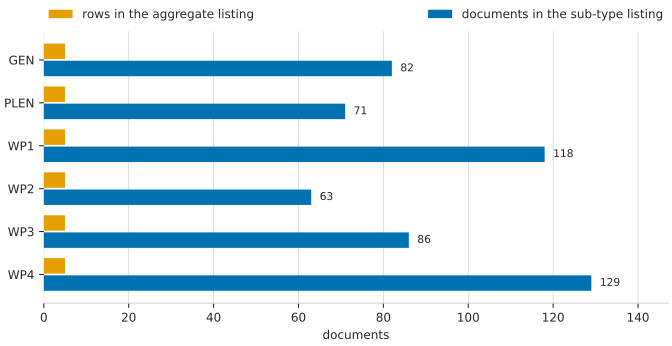
The listing of the temporary documents of a meeting shows only a preview of
five documents per sub-type, no matter how large the page size is. The
meeting T25-SG13-250303 has 549 temporary documents, but its aggregate
listing holds 30 rows — five for each of the six sub-types GEN, PLEN,
WP1, WP2, WP3 and WP4. The listing of a single sub-type holds all of
them, and the aggregate page links to it.
The package therefore reads the aggregate listing, collects the sub-types it offers and reads every sub-type listing. A meeting with a single sub-type is unaffected: the aggregate listing offers that sub-type, and its listing is read in full like any other.
The listing of a study period knows more than the meetings
The meeting index of a study group does not list every meeting a document
was posted to. The listing of the study period T09-SG15 holds 2390
contributions, the listings of its eight meetings hold 2379 of them together,
so eleven contributions — nine posted on 5 May 2009, one on 6 May 2009 and one
on 8 October 2010, before or between the listed meetings — appear in the
listing of no meeting. For T25-SG13 and T17-SG15 the two routes agree: 972
and 2858 contributions, each in the listing of a meeting.
sync lists the meetings one by one and then reads the listing of the whole
study period, so it also stores a contribution posted between two meetings —
without a meeting. fetch_documents without a meeting reads that period
listing directly; see the Python API.
Downloads
A document is downloaded from a path that carries the access level of the document type:
| Type | Path | Access |
|---|---|---|
| Contribution | /dms_ties/itu-t/md/{sp}/sg{sg}/c/{id}!!{format}-{lang}.{ext} |
TIES account |
| Temporary document | /dms_inf/itu-t/md/{sp}/sg{sg}/td/{meeting}/{subtype}/{id}!!{format}-{lang}.{ext} |
TIES account |
| Collective letter | /dms_pub/itu-t/md/{sp}/sg{sg}/col/{id}!!{format}-{lang}.{ext} |
public |
| Report | /dms_ties/itu-t/md/{sp}/sg{sg}/r/{id}!!{format}-{lang}.{ext} |
TIES account |
{sg} is the zero padded study group, so study group 5 becomes sg05.
The public path is a property of the DMS, not a promise of the package. A download goes through the authenticated client, so a collective letter still needs TIES credentials unless its rendition is already in the file cache.
{sp} is the two-digit start year of the study period, {format} the format
code (MSW for Word, PDF, ZIP, HTM) and {lang} the language code
(E, F, S, A, C, R).
The extension is the one of the published file and is not implied by the
format: a Word document may be a .docx, a .doc or a .msw file, and
T25-SG13-R-0001 is published as !!MSW-E.doc only. The extension of the
download URL is therefore the authoritative one.
Revisions
A revised document replaces the !! separator by !R1!, !R2! and so on:
/dms_ties/itu-t/md/25/sg02/c/T25-SG02-C-0001!!MSW-E.docx    the original
/dms_ties/itu-t/md/25/sg02/c/T25-SG02-C-0001!R1!MSW-E.docx   the first revision
The detail page of a document lists the original and every revision, and a revision may be published in more languages than the original. The package prefers the original and falls back to the lowest revision when the original is gone.
Existence
A status code does not tell whether a document exists. The access policy
answers with a redirect to the identity provider before it validates the
path, so a real and a made up rendition of a protected document look the same.
Only the public prefix (dms_pub) validates the path directly. The reliable
way to find out whether a document exists is its listing or its detail page —
a document that does not exist answers with a page of about 7 kB that carries
no identifier.
Authentication
The protected documents are behind the F5 BIG-IP access policy at
auth.itu.int, which delegates to the SAML identity provider at
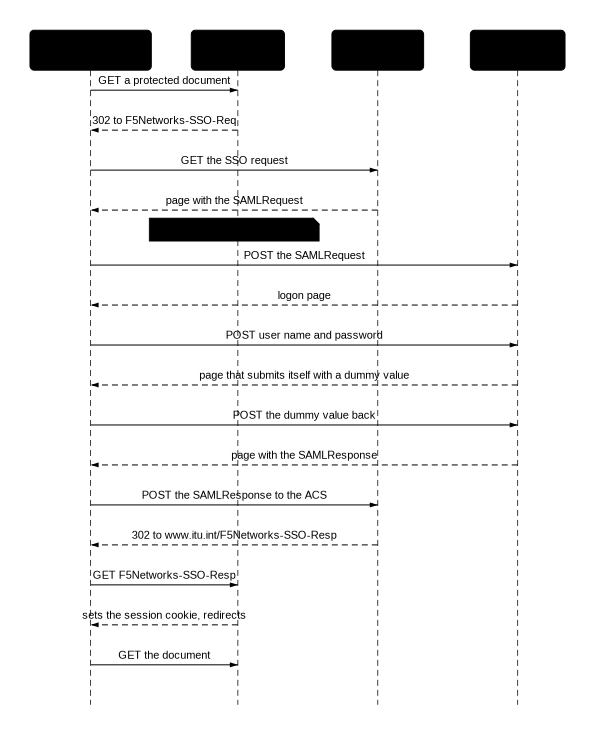
login.itu.int. A complete download has six steps, but the handshake itself
is the four posts in the middle:
- Request a protected document. The access policy answers with a redirect
to
auth.itu.int/F5Networks-SSO-Req?SSO_ORIG_URI=…, which serves a page carrying a SAMLAuthnRequestfor the identity provider. - Post the
SAMLRequesttologin.itu.int/saml/idp/profile/redirectorpost/sso. The identity provider answers with its logon page. - Post the user name and the password to
login.itu.int/my.policy. The identity provider answers with a small page that submits itself and carries adummyvalue. - Post that
dummyvalue back tologin.itu.int/saml/idp/profile/redirectorpost/sso. The identity provider answers with the page that carries the SAMLResponse. - Post the
SAMLResponsetoauth.itu.int/saml/sp/profile/post/acs, the assertion consumer service. It answers with a redirect towww.itu.int/F5Networks-SSO-Resp, which establishes the session cookie onwww.itu.intand redirects to the requested document. - Fetch the requested document. The session cookie authorises every
further request under
/dms_tiesand/dms_inf.
www.itu.int when the assertion consumer service redirects back.Two things are worth knowing:
- The handshake has to start at a protected resource. A session that was opened for a public page does not authorise the document files.
- The login is finished when the assertion consumer service accepted the
response. What the requested document answers afterwards — a file, a
404, an error page — does not say anything about the login.
The package implements this chain in itu_t_documents.auth.ties. The
session cookies live in the HTTP client, so one login serves every following
request.
The membership of the account
A TIES account is valid for the whole ITU-T, but its membership covers only the study groups it belongs to. The login succeeds either way — the access policy decides about the resource after the identity provider has answered.
A document outside the membership answers 401 Unauthorized with a page that
says "Access is denied due to invalid credentials". The credentials are
valid; the membership is not wide enough. The package reports this as an
AccessDeniedError and never logs in again.
The metadata of a document is public: the listings, the detail pages and the structure pages are read without a login, and only the file itself is protected.
Where the credentials come from
itu_t_documents.config.Settings resolves the TIES credentials from the
highest priority source that provides them. The priority is per setting:
- the environment variables
ITU_TIES_USERNAMEandITU_TIES_PASSWORD, - the
[credentials]table of~/.config/itu-t-documents/config.toml, - a secretspec provider, when the
optional
secretspecextra is installed and asecretspec.tomldeclares the two secrets under the provider aliasitu-ties.
The secretspec layer lives in itu_t_documents.config.secretspec_source. It
contributes the two credentials only as a pair — when either value is missing it
contributes nothing — and it is ignored entirely when the extra is not installed
or the provider cannot be resolved. Installing the package without the extra
therefore behaves exactly as before.
Where the manifest lives
secretspec looks for a file named secretspec.toml in the current directory
and its parents. It knows no other location: neither ~/.config/secretspec/
nor ~/.secretspec.toml is searched, and
~/.config/secretspec/config.toml holds secretspec's own configuration (such
as [audit] enabled = false) rather than a manifest.
The package therefore resolves the manifest itself, in this order:
ITU_SECRETSPEC_MANIFEST,- the
general.secretspec_manifestkey of the configuration file, secretspec.tomlin the configuration directory, when the file exists,- the discovery of secretspec itself.
A manifest that cannot be read — a missing file, a directory — yields no credentials instead of an error, so the other sources keep working.
Page size and pagination
The document listings are paginated. The number of documents per page is kept
in the cookie ITUDMS_PageSize; the page size control of the web interface
offers 10 to 900. The package sets it to 900. The cookie is a correctness
requirement and not a tuning knob: without it the listing of the
contributions of T25-SG05-250603 holds 50 of 396 rows.
A listing with more than 900 documents spans several pages. The
contributions of T25-SG13 are 972, those of T25-SG15 1211 and those of
T17-SG15 2858, so the listing of a study period does not fit on one page.
Every page but the last one links to the next one (Next), and the package
follows that link. The listing of a single meeting stays below 900 documents —
the largest has 452 — so a meeting is always read from one page.
The listing pages report their size (Results: 82), so the package compares
the reported number with the number of documents it parsed from every page
and refuses an incomplete listing with IncompleteListingError instead of
storing a part of it silently.
The aggregate listing of the temporary documents of a meeting is the one exception — it previews five documents per sub-type whatever the page size is (see above).
Character set
The meeting document pages are encoded in ISO-8859-1 but do not declare it in
their content type header, while the net4 applications use UTF-8. The HTTP
client therefore falls back to ISO-8859-1 when the response declares no
charset.